
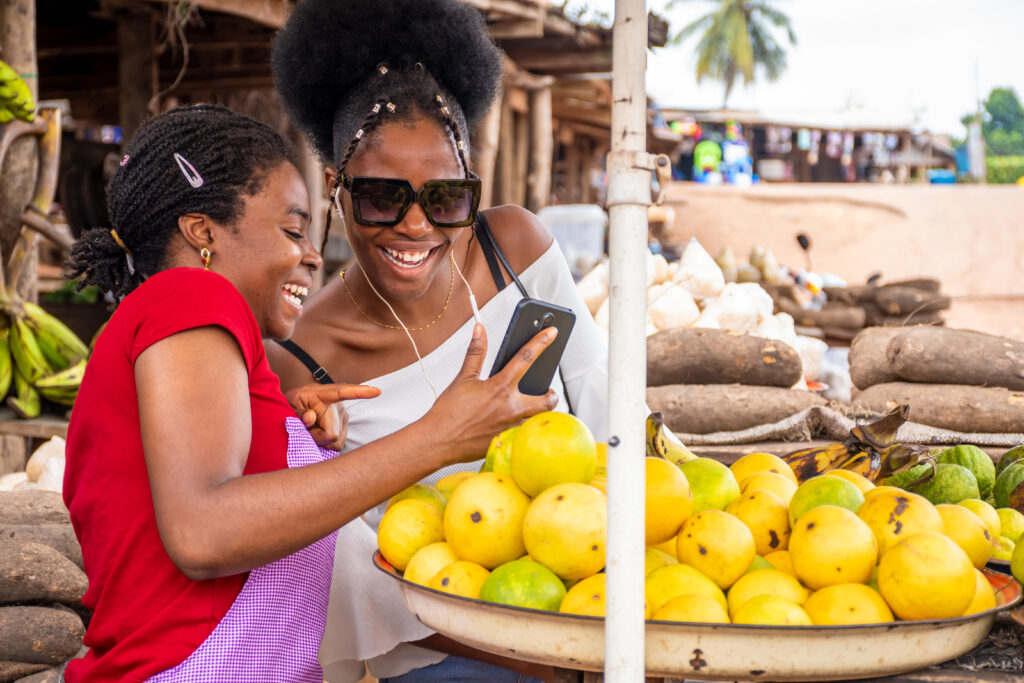
There’s hardly a street in Lagos without at least one side hustle hiding somewhere. A POS table here. A salon there. Frozen food, bake shop, shawarma stand, thrift clothes vendor, laundry, phone repair shop. You name it.
Everywhere you turn, somebody is making something work with pure stubbornness and ingenuity.
Nigerians are not short of ideas. Rather, we’re short of rails.
Open banking will not magically fix that. It’s not a messiah, as we’ve said countlessly. But it is a rail.
And if we’re honest, some of the innovations we already have are bumping their heads against ceilings that data access, standardization, and proper plumbing can remove.
This is not about the apps we could build one day with open banking. This is about what already exists today in Nigeria and how open banking can make those things sharper, fairer, and more scalable.
The problem isn’t innovation.
If you look at Nigeria only through “big tech” headlines, you’ll miss the real story.
According to the most recent estimates, roughly 36.8% of adults remain unbanked, and many more are under-banked or only intermittently served.
At the same time, we have millions of businesses contributing to nearly half the national GDP with no formal structure.
Most have more than one bank account, but no single institution sees the full picture. Lenders, wallet providers, and fintechs are trying to help, but they’re working blind, or at least half-blind.
We already have digital lenders like FairMoney, Carbon, and co. We have infrastructure like Lendsqr powering lenders behind the scenes. We have personal finance tools like PiggyVest, Cowrywise, and Rise. We have SME tools and neobanks like Moniepoint Business and Opay trying to solve bookkeeping, collections, and cash flow for smaller businesses.
These are not theoretical startups. They’re in production, and Nigerians already rely on them. But all of them hit the same wall.
Most providers rely on limited or alternate data and don’t get a full view of a customer’s real financial picture.
Open banking, if implemented properly, doesn’t give them more power. It gives them more context with the customer in charge. And that context changes everything.
1. Credit scoring for the underbanked
It’s only right to start with credit. Open Banking Nigeria itself was born, in part, out of a simple, stubborn frustration: Why is it so hard for a responsible Nigerian to access fair credit?
To be fair, the system today isn’t completely broken. We have banks giving loans to their “best behaved” customers. We have digital lenders genuinely trying to reach the people that banks ignore. We have infrastructure players making it easier for SACCOs, MFIs, and fintechs to lend at scale.
But even with all that, traditional lending in Nigeria is still biased toward people with formal salaries and collateral, or people willing to accept unfair or heavy-handed terms.
Meanwhile, a large portion of Nigerians don’t fit that mould.
Walk down any major street, and you’ll see people running bike logistics, repairing car tyres, or frying akara on a warm Saturday morning. These are all business owners.
Most don’t pay themselves a structured salary or keep proper books. Their assets don’t always look impressive on paper. Yet money flows through their hands every single day. They manage risk, manage relationships, and keep the lights on.
The current system barely serves them.
What lenders see today
If you run or work in a lending business, this will sound familiar. A typical application might come with one bank account, three to six months of transaction history, and very limited behavioural data beyond “debits” and “credits”.
Your risk model doesn’t fully understand this person, so you do what any rational lender does when information is thin: you reduce ticket sizes, you increase pricing, or you simply say no.
What open banking changes
Open banking doesn’t invent new data. It simply lets the customer securely grant access to their data across multiple banks, standardises how that data is requested and shared, and ensures the customer fully understands how their data is used.
Put simply, with proper open banking, a lender can say to a customer:
“If you want us to make a better decision about you, connect your accounts securely. Here’s exactly what we’ll see and exactly what we’ll use it for.”
With the customer’s consent, the lender sees the inflows across all the customer’s accounts, evidence of regular payments, stable purchase patterns from recurring customers, and how the person behaves with money over time.
The risk model stops seeing only a tiny slice and starts seeing consistency, discipline, and credibility.
The immediate impact isn’t that everybody suddenly gets a loan. The real impact is better risk decisions.
2. Financial management for Nigerian businesses
A surprising number of “small businesses” in Nigeria are not that small. They just look small because their structure is chaotic.
It’s common to find one person juggling multiple businesses. Funds moving freely between “personal” and “business” accounts, and even records scattered between bank alerts, WhatsApp chats, and Excel sheets.
Excel is doing God’s work, but it’s not magic.
A lot of the SME tools that exist today rely on manual entries and discipline that many owners simply don’t have the time, training, or patience for.
The result is predictable. The business owner doesn’t have a clear view of profit vs. cash. They don’t fully know what they owe, what’s owed to them, or where they’re leaking money.
Where open banking fits
A business uses two accounts, say, one with Moniepoint for incoming payments and one with Sterling for expenses.
With open banking, the owner connects both accounts to a bookkeeping tool once. From that moment, transactions are pulled automatically and categorised into supplier payments, rent, salaries, stock purchases, refunds, tax, etc.
At the end of each month, the SME can see a structured view of their revenue, major expense categories, gross margin estimates, and maybe even a simple forecast.
From there, the ripple effects show up naturally. Decisions around restocking, expansion, and pricing become more informed. That same tool can generate lender‑ready summaries with actual bank‑verified history behind them.
We already have SME tools and neobanks doing the Lord’s work. Open banking doesn’t replace them. Rather, it simply gives them the data they need to reach the millions who’ve always been overlooked.
Spotlight read: How Open Banking will help businesses with money management
3. Holistic personal finance management
Nigerians are not waiting for anyone. We already use PiggyVest, Bamboo, and others to discipline our savings and investments, and a mix of bank apps to pay bills, send money, and categorise spending.
The big problem here is fragmentation.
Your salary might land in one bank. Your “main” ATM card is from a different bank. Your savings live in a high-interest wallet. You keep a Kuda account for bill payments and maybe Paga for transfers when the network is acting up.
No single app sees more than a narrow slice of your actual financial life.
What open banking could enable
Open banking changes the equation for any service provider building personal finance tools.
Instead of building yet another isolated view of one account, they can, with consent, connect a customer’s banks and wallets in a secure, standardised way.
Suddenly, some useful, very Nigerian features become realistic:
- A unified view of spending that shows how much you actually saved, spent, or lost in fees across every bank you use.
- Automated savings rules that don’t just hammer one account but look across your balances on a given day and pull smaller amounts from multiple places while still hitting the same target.
This already exists in more mature markets, and it is not a copy‑and‑paste wishlist. It’s a natural extension of what Nigerians are already doing manually.
Open banking just gives people a dashboard and an additional logic layer on top of that reality.
4. Smarter fraud detection
Let’s be honest: Nigerians are exhausted with fraud stories. Every week, someone posts a thread about money vanishing from their account, transfers sent to the wrong person, a fraudulent debit from a POS, or a hijacked SIM used to clean out balances.
Banks do try. But each bank mostly sees only what happens inside its own walls. Right now, each institution has its own fraud models based on what it knows about its customers.
What could change with better data sharing
It’s important to note that open banking itself is not a silver-bullet fraud engine.
Open banking is built on consent. When customers connect their accounts to a new app under an open‑banking model, they’re agreeing to share specific data for specific purposes.
Fraud monitoring that cuts across multiple institutions would need either:
- explicit consent from customers, or
- a clear regulatory framework that allows certain anonymised or aggregated intelligence to be shared for security reasons.
We are not there yet in Nigeria. But we can see some directions where open banking can help.
First, inside each institution, better, standardised access to customer transaction history makes bank‑level fraud models stronger. The bank can more easily analyse customer behaviour over time and across products, spot internal anomalies faster, and reduce internal blind spots.
Second, open banking makes it more technically feasible for regulated players to cooperate on fraud intelligence because there is a standardized way to exchange verified data.
Third, open banking gives fintechs cleaner, tamper-proof ways to validate customers. It removes entire categories of fraud built on doctored statements or altered documents, and it improves checks that confirm whether an account actually belongs to the person using it.
So yes, we can imagine a future where your bank can slow down a clearly abnormal transaction and ask you to double‑confirm. But we have to build that future responsibly, with the right mix of privacy, consent, regulation, and industry collaboration.
5. Invisible and embedded finance
Let’s move to a very familiar kind of wahala.
You’re in an Uber heading to work. The ride ends, and you realise that the money you budgeted for transport for the month has finished. Your salary is three days away, but the balance in your main account is looking dry.
Today, your options are messy.
You start calling or texting friends, rush to a loan app and hope it pays out fast enough, or you break a savings plan that was never meant to cover this type of emergency.
None of this is smooth, but it’s a common pain point.
What embedded finance could look like
In a typical week, people are paying for rides, ordering food, buying data, paying school fees, shopping on Jiji, sending money to family, and topping up electricity. Everyone wants to move through life without friction. Embedded finance makes this possible by quietly showing up inside the apps and channels Nigerians already use.
We already have very early forms of this with Buy-Now-Pay-Later (BNPL) at checkout, airtime/data advances, card‑on‑file payments, and so on. But most of it still runs on narrow and custom integrations. Open banking deepens this.
For service providers, open banking lets you plug your services directly into places where people are already transacting. With proper consent and APIs, finance starts to hide in the background.
Embedded credit:
Circling back to the earlier scenario, you’re about to pay for a product or service, but your balance won’t quite cover it. At checkout, you see a clear, in‑context option:
“You’re short ₦5,000. Here’s a 3‑day loan of ₦5,000, repay by [date], total cost ₦X?”
You accept once, complete your ride or order, and the system automatically debits you on the agreed date.
Embedded payments
Rather than switching between apps to make payments, with open‑banking‑powered account‑to‑account payments, you pick your bank inside that portal, authorise a secure debit, and complete a transaction, and the recipient receives instant confirmation.
Embedded insurance
With open banking, insurers can integrate with service providers to offer small, relevant covers right where they make sense:
- travel cover when you pay for a flight,
- device insurance when you buy a phone,
- health micro‑cover tied to specific payments or merchants.
Premiums can be collected in tiny, flexible amounts that follow actual cash flows rather than rigid dates that don’t match reality.
Again, we already see pieces of embedded finance today
What changes is that service providers can make decisions with multi‑bank, standardised data. They can also embed services once and connect to multiple banks through shared pipes.
Open banking is not what creates the idea. What it improves is the precision, fairness, and user experience.
6. Non-generic insurance
Insurance, for many Nigerians, lives at the edge of their life. You renew a third‑party motor to avoid police trouble, and not because you believe in its value. If you’re lucky, your employer gives you HMO coverage, and that’s the end of your thinking about health insurance.
A smaller group actively buys retail products, life cover, device insurance, and extended health, but they’re still the minority.
Part of the problem is emotional. Insurance feels abstract until something goes wrong. But part of it is structural. Many products are priced using very broad assumptions.
They’re not really tuned to a person’s actual income pattern, risk profile, or spending behaviour. Premium schedules are often rigid, and distribution still leans heavily on agents, banks, or employer partnerships.
Open banking, especially as we move from pure open banking to a fuller open finance, can quietly shift this.
Open banking helps insurance companies do a few things better.
- They can verify identity and income more accurately instead of relying only on declarations.
- They can design pay‑as‑you‑earn or pay‑as‑you‑use products that sit on top of real transaction flows.
- They can also experiment with more flexible premium schedules. Instead of “pay once a year” or “pay this fixed amount every month”, you can build “pay small whenever your account crosses this threshold” or “deduct tiny amounts linked to certain patterns”.
For this to work at scale, insurers need structured, standardised, consented views of financial history and patterns. That is exactly what open banking is trying to normalise.
7. Even better payment options
Finally, payments. Nigeria has done considerably well in moving to a cashless system.
POS terminals are easily accessible, most transfers move rapidly when the networks are in our favour, and wallets like OPay, PalmPay, Moniepoint, and others have pulled millions into formal banking.
Yet the experience for small vendors is still fragile; network issues, delayed alerts, reversals, and disputes that eat up time and trust, and worst of all, relying on screenshots as proof of transfer. People are constantly half‑afraid that the next transaction will be the one that hangs.
Open banking isn’t a card network or a switch, but it does enable clean account‑to‑account payments where the payer authorises a debit directly from their bank.
For some use cases, where regulation allows, and trust is high, open banking also enables pull payments, where instead of the customer manually making a payment, the vendor or payee can initiate a payment request and have the payer approve.
In both cases, the merchant gets real‑time confirmation. This also reduces the need for physical cards or other stressful payment options.
Why all this matters
None of these ideas is science fiction. Pieces of them already exist in Nigeria.
The bottleneck is access and structure. Access to complete, consented financial data; consistent ways to plug into banks without reinventing integration every time; and a shared trust framework so everyone knows the rules.
Open banking doesn’t give Nigerians new brains, new hustle, or new ambition. We already have those in abundance.
What it can give, if we take it seriously, is better foundations.
If we build lazily around it, open banking will just be another buzzword that never quite touches the ground.
If we build with it, grounded in how Nigerians actually earn, spend, borrow, save, and survive, it becomes a solid foundation under the innovations Nigerians already rely on.
